Automating Your Work Is Only 60% — Your Real Moat Is What You Remember
AI has made execution almost free. So a lot of people think wiring up an agent means they've won. It doesn't — that's the pass mark. When everyone can ship in an afternoon, the game comes back to one question: whose judgment is better? And judgment has no shortcut. It compounds from what you've accumulated. Here's why your knowledge base is quietly becoming the last moat that matters.
AI has made execution almost free. Writing code, designing graphics, drafting copy, crunching numbers, answering tickets — work that used to cost a human hours now ships from an agent in minutes.
So a lot of people figure: I've wired an agent into my workflow, I'm 40% faster, I've won.
That's a comfortable illusion. Automating your work is only 60% — barely a passing grade. The real competition starts after the 60%.
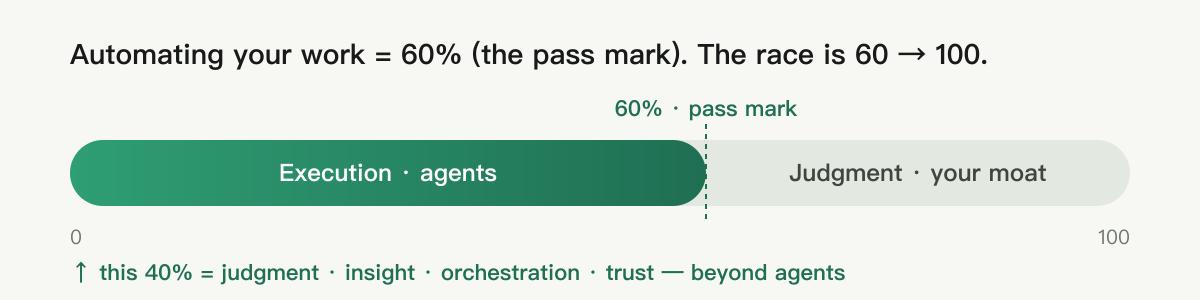
The 60% bar: there should be no "you" left in the loop
Most people's idea of "embracing AI" stops at "I got faster." That's nowhere near enough.
The real bar is harsher: you have to take yourself out of the execution loop entirely — not use the agent as your assistant, but remove yourself from the work. When a task runs, the agent delivers, and you aren't in the pipeline. Look at your daily work and you shouldn't be able to find "you" in it.
That's the pass mark. Because only once you're out of execution do you have the headroom for the questions an agent can't answer for you: What does the user actually need? Which high-value thing has nobody built yet?
Here's the cleanest way to see it. Getting from 0 to 60% means pulling the human out of the loop. Getting from 60% to 100% means putting the human back in — but in a different seat. In the first loop you were doing the work. In the second, you're deciding what work is worth doing. Automation is the means. Freeing your judgment is the point.
After 60%, the scarce thing changes
For years the game was traffic, content volume, supply chains, operational efficiency. Those still matter, but agents are dissolving their scarcity fast:
- When an agent generates content, places ads, and optimizes conversion in real time, content output stops being scarce.
- When an agent runs support, analysis, and competitor monitoring 24/7, operational efficiency stops being scarce.
So what gets more scarce?
A deep read on what users actually want. Agents execute; they don't define the problem. "What does the user really need" leans hard on human experience, taste, and repeated contact with the real thing. Whoever sits closest to the user and frames the problem best holds the highest-leverage card.
System design. Pointing one agent at one task is getting trivial. The moat is orchestrating many agents into a system that handles something genuinely complex. That's judgment and design — not tool usage.
Trust. As AI-generated content floods every channel, people find it harder to tell what's real. A genuine person, a judgment worth trusting, suddenly appreciates in value.
All three share a trait: they're the calls an agent can't make for you — and judgment is the one thing in this whole shift that's going up in price.
The question everyone skips: where does judgment come from?
People stop at "judgment is scarce." But there's a hole nobody fills:
Judgment isn't a gift, and it doesn't switch on just because you've been freed up. Take someone who shovels work all day, lift the shoveling off them, and they don't suddenly acquire great judgment — they acquire free time.
Real judgment compounds from knowledge and experience accumulated over time.
- You spot a fake requirement at a glance because you've stepped on ten just like it.
- You bet big on a direction because you carry a map nobody else has — woven from a pile of first-hand signals and calls you've tested and re-tested.
- You make the right move inside an afternoon-long iteration not from a flash of insight, but from raw material you banked long ago.
You can outsource execution to an agent. But the ammunition for judgment has to be something you stockpiled yourself. It's the kind of thing that takes time to grow and can't be copied — which is exactly why it can become a moat.
The counterintuitive payoff: the better agents get, the more your accumulation is worth
Connect the chain and you land somewhere that runs against instinct:
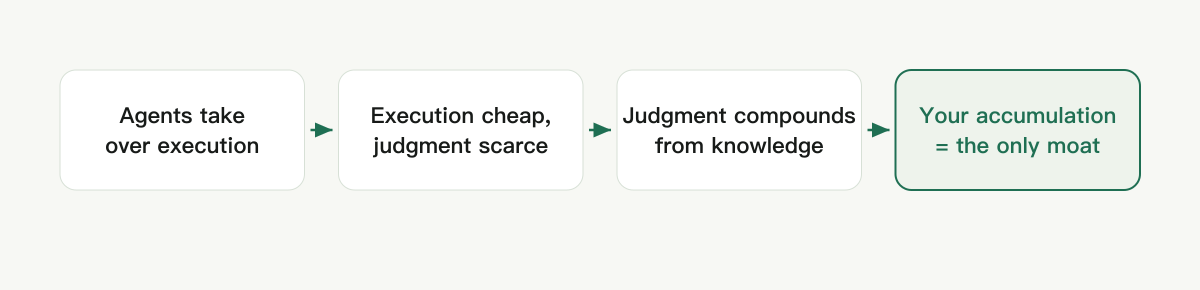
Your old moat might have been "I code better than you," "I design better," "I can out-grind you." Agents are leveling each of those, one by one.
What's left when they're done is the body of knowledge in your head that nobody else has — what you've read, figured out, gotten wrong, and verified. Automation drives the cost of execution toward zero, and in doing so it promotes "what you've accumulated" to the last — and most expensive — variable.
The catch: your accumulation is evaporating
Here's the brutal part. For most people, accumulation leaks the whole time.
The thing you figured out in a deep session is gone the moment you close the tab. The sharp take you read goes into a bookmarks folder you never reopen. The mistake you learned from gets repeated in a slightly different costume. You think you're accumulating; you're actually relearning-and-reforgetting on a loop.
The AI era adds a new way to leak: more and more of your thinking now happens inside chats with AI. You reach a genuinely good call with Claude or ChatGPT — and it stays trapped in that one conversation. The next model, the next window, can't reach it. Your raw judgment material is scattered across a dozen sealed chat boxes, evaporating with the context.
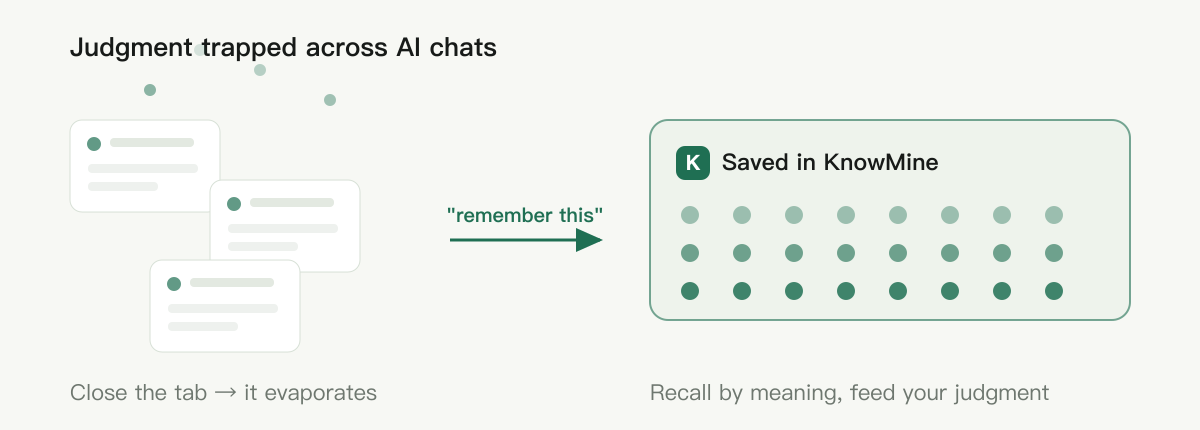
That's the gap KnowMine is built to close: give your judgment a stockpile that doesn't evaporate.
- Say "remember this" in any AI conversation and it writes straight into your own knowledge base over the Model Context Protocol — no break in your flow. Caught a thought on a walk or in a meeting? Drop a voice note; KnowMine transcribes, distills, and files it, title and tags included.
- Pull it back by meaning, not keywords — describe the problem and surface a call you made three years ago, instead of digging through a bookmarks graveyard.
- Once you've banked enough, KnowMine builds a cognitive portrait from your knowledge — a Soul Profile that teaches the AI how you actually reason, so its suggestions start carrying your judgment instead of the internet average.
- And none of it is locked to a single AI — switch from Claude to ChatGPT and the knowledge base stays yours.
Agents handle execution. Your knowledge base feeds your judgment. The first keeps getting cheaper; the second keeps getting more expensive.
What to actually do after 60%
If you buy the chain — judgment comes from accumulation — the move is simple:
- Bank every valuable thought the moment it lands. A good call from an AI chat, a take that could change a decision, a mistake whose root cause finally clicked — drop it into a knowledge base an AI can read, instead of betting you'll remember.
- Make it searchable by meaning, not piled into a folder. A bookmarks folder is where knowledge goes to die, because you never think to open it. If you can pull it back with one sentence, it counts as accumulation.
- Wire it back into your agent workflow. When an agent works on your behalf, let it read your past calls and hard-won mistakes — so its output carries your read of the world, not the web's average.
AI has already compressed "idea to product" to an afternoon. That's the new baseline. But when everyone can ship that fast, the deciding factor falls back to the oldest question there is: whose head holds something nobody else's does.
That something is worth stockpiling on purpose — not letting it evaporate with every chat window you close.
Your knowledge and memory, always yours.
Want to give your judgment a stockpile that doesn't evaporate? Connect KnowMine to your AI conversations and start accumulating with a single "remember this."
Start building your AI-native knowledge base
Free to start. Connect to Claude, ChatGPT, and more.
Get Started Free